How long does Cordyceps take to work?
How long cordyceps takes to work: what human trials found at week one and week three, how it differs from caffeine, and how to time your daily drops.
Contents
- Two clocks: the same day and the third week
- Week one versus week three: the Hirsch trial
- Why cordyceps is not a quieter caffeine
- What shapes your personal timeline
- Before or after a workout?
- Can I take it with coffee?
- Will I feel anything in the first week?
- What if I miss a day?
- The patient end of the shelf
The honest answer has two halves. Cordyceps is not a pre-workout shot: nobody has shown that a single dose meaningfully improves your training an hour later, and the strongest human data point the other way — the measurable changes appeared after weeks of daily intake. But there is also a small recent crossover trial that found same-day shifts in oxygen uptake and reaction time after one serving of Cordyceps militaris. So the full answer is: treat the 30–60 minutes before a workout as a ritual that keeps the habit alive, and treat the real effect, if it comes for you, as cumulative over two to four weeks. Below is what the studies actually measured, why cordyceps is not a quieter caffeine, and how to time the drops.
Two clocks: the same day and the third week
The acute side rests on one study, so hold it lightly. In 2026, Farzan and Koushkie Jahromi published a randomised, double-blind, placebo-controlled crossover trial in PLoS One: twelve recreationally active people took Cordyceps militaris or placebo on separate days, and on the cordyceps day the researchers recorded elevated resting oxygen uptake and faster reaction times around exhaustive exercise. Twelve participants, a single dose, one research group. That is a genuine and interesting signal — and exactly the kind that needs replication before anyone builds promises on it. What it does not show is a stronger workout in the way a stimulant produces one.
The cumulative side is where the older and larger part of the evidence sits. Every human trial that found anything used daily dosing for weeks, and the design of the most cited one separated the timeline deliberately: the same participants were tested after one week and after three. That structure is a gift for anyone asking “how long”, because it answers the question inside a single experiment rather than by comparing different studies.
Week one versus week three: the Hirsch trial
The trial is Hirsch and colleagues, 2017, in the Journal of Dietary Supplements. Twenty-eight young, recreationally active adults took 4 grams a day of a mushroom blend containing Cordyceps militaris, or a maltodextrin placebo, in a double-blind design. After one week the main analysis found no significant difference from placebo in VO2max, ventilatory threshold or time to exhaustion. After three weeks — the ten participants who continued — VO2max in the blend group had risen by about 4.8 ml/kg/min against roughly 0.9 on placebo, with a p-value of 0.042. A secondary confidence-interval analysis also suggested longer time to exhaustion: on the order of +28 seconds after one week and +70 seconds after three.
Read the shape of that result, not just the numbers. The oxygen-side changes — VO2max and the ventilatory threshold, the point where breathing has to ramp up sharply — became significant only at the three-week mark. Whatever the blend was doing, it behaved like a slow adjustment, not a switch. And keep the caveats attached: twenty-eight people shrinking to ten, a blend rather than pure cordyceps, one trial. It is the best timeline data we have, and it is still thin ice.
Why cordyceps is not a quieter caffeine
Caffeine works fast because its mechanism is fast. As the classic 1999 review by Fredholm and colleagues lays out, caffeine’s stimulant action comes from blocking adenosine receptors: adenosine is the molecule your nervous system accumulates as a fatigue signal, and caffeine plugs the receptor so the signal stops arriving. The tiredness itself keeps building behind the block, which is why the effect arrives within the hour — and why it ends in a dip when the block wears off. It is borrowed alertness, repaid with interest.
Cordycepin, the compound cordyceps is studied for, sits on the other side of that system. It is adenosine’s near-twin by structure, and the research interest around it concerns cellular energy and oxygen handling — the metabolic side, not the alarm-silencing side. The practical consequence is the one people report: no spike, no jitters, no crash, and therefore nothing to “time” pharmacologically. Taking the drops 30–60 minutes before training is a fine ritual because rituals keep habits alive; just do not confuse it with a pre-workout window. The mushroom is not racing to reach your muscles before the warm-up ends.
What shapes your personal timeline
Training status matters, and the null results prove it. In 2004, Parcell and colleagues gave 22 endurance-trained male cyclists 3 grams a day of a Cordyceps sinensis product (Cs-4) for five weeks: VO2peak, ventilatory threshold and a time trial all stayed flat. Five weeks, decent dose — nothing, in people whose aerobic systems were already well tuned. Compare that with Chen and colleagues in 2010: twenty adults aged 50 to 75 took Cs-4 for twelve weeks, and their metabolic and ventilatory thresholds rose about 10.5% and 8.5% respectively — while VO2max, tellingly, did not move. The pattern across the literature is that cordyceps shows more where there is more room to improve, and less where the ceiling is already near.
Preparation matters too, and this is where honesty is owed. Every trial above used capsules or powder blends at gram-level doses — not liquid extracts measured in millilitres, and not our product. There is no legitimate conversion between 4 grams of a mushroom blend and 1–2 ml of a dual extract, and we will not invent one. What transfers is the shape of the effect — daily, cumulative, weeks long — not the dose or the numbers. One more practical note: at the label serving of 1–2 ml a day, a 30 ml bottle lasts 15 to 30 days. That is volume arithmetic, not a prescribed course — but it conveniently brackets the two-to-four-week window the research asks you to allow.
Consistency, finally, outweighs timing. In these studies the dose arrived every day, including rest days, because the thing being adjusted is not the workout but the background the workout happens against. Skipping days stretches your personal timeline; anchoring the dropper to something fixed — the gym bag, the morning kettle — is worth more than any minute-counting before a session.
Before or after a workout?
Before is the common habit, and it is a reasonable one: the 30–60 minutes ahead of a session is a slot that exists on training days and is easy to remember, and the small acute trial above at least does not contradict it. But nothing in the evidence makes “after” wrong. If taking it before feels tied to a stimulant expectation you would rather drop, move it to the morning and keep it daily — the research design cares about the daily part, not the clock part. On rest days, morning is the natural slot.
Can I take it with coffee?
Yes — no established conflict, and the pairing is common. They also answer different needs: caffeine silences the fatigue signal for a few hours, cordyceps is studied around the energy metabolism underneath. If your real question is “can cordyceps replace my pre-workout coffee”, the honest framing is that it is an alternative in character, not in immediacy. People who switch describe giving up the spike-and-dip, not getting the same thing from a different bottle. And if you keep both, keep the picture straight: the extract does not cancel the espresso, and neither replaces sleep.
Will I feel anything in the first week?
Probably nothing dramatic, and expecting that protects you from a bad verdict. The one-week marks in the research were, on the main analysis, indistinguishable from placebo; the changes lived at week three. What people sometimes report early is subtler — a steadier second half of the workout, an easier morning start — and subjective notes like these deserve a notebook more than they deserve excitement. Judge the bottle at the bottom of it: two to four weeks of uninterrupted daily use, then a fair review. Feeling nothing after two droppers on day one is not a verdict; it is the expected state of affairs.
What if I miss a day?
Nothing resets. Take the normal serving the next day — do not double it to catch up. A cumulative effect that takes weeks to build does not evaporate in 24 hours. One missed day inside an otherwise steady course is noise; a missed week is a reason to simply restart your count with patience, not with a bigger dose.
The patient end of the shelf
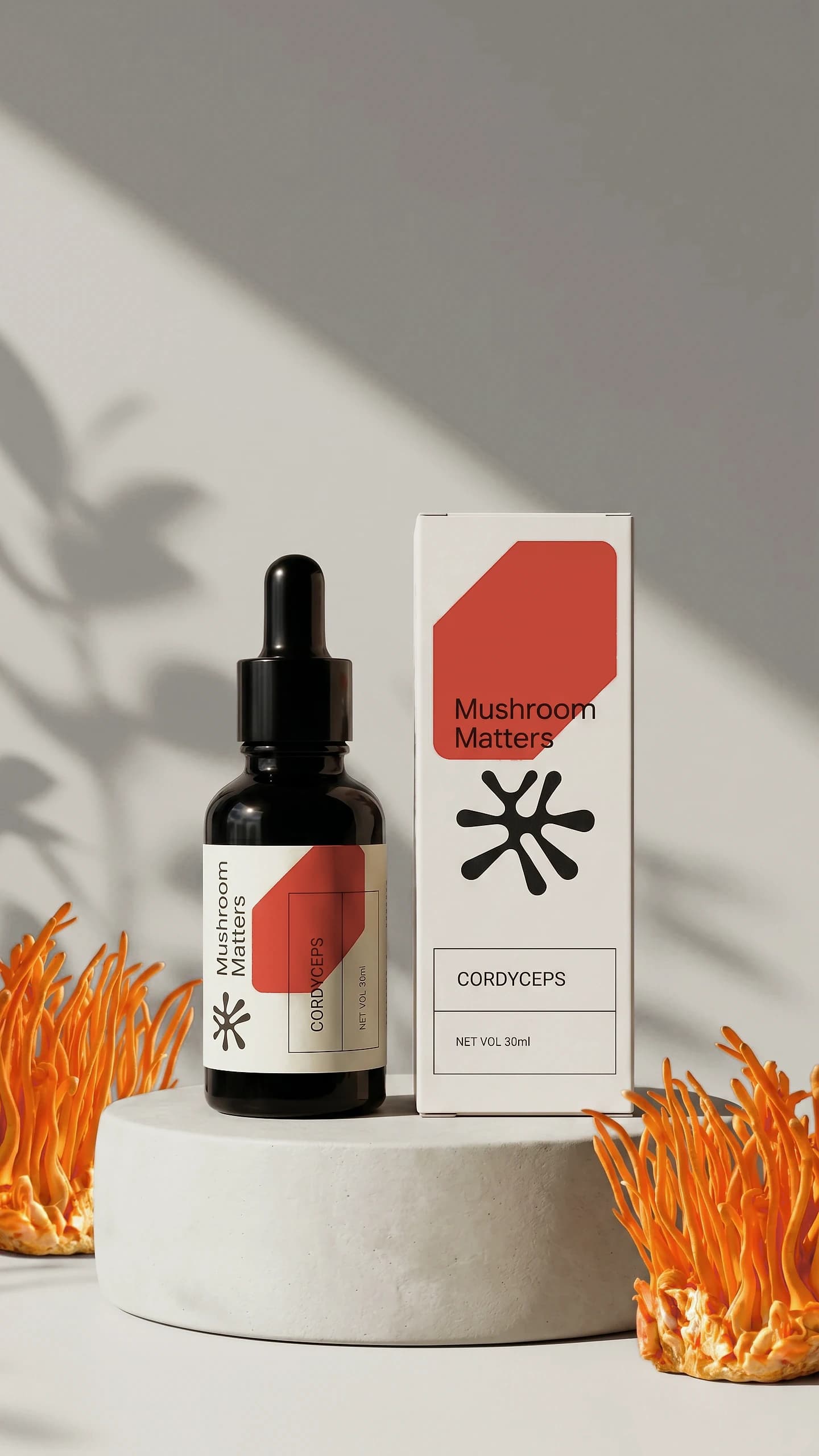
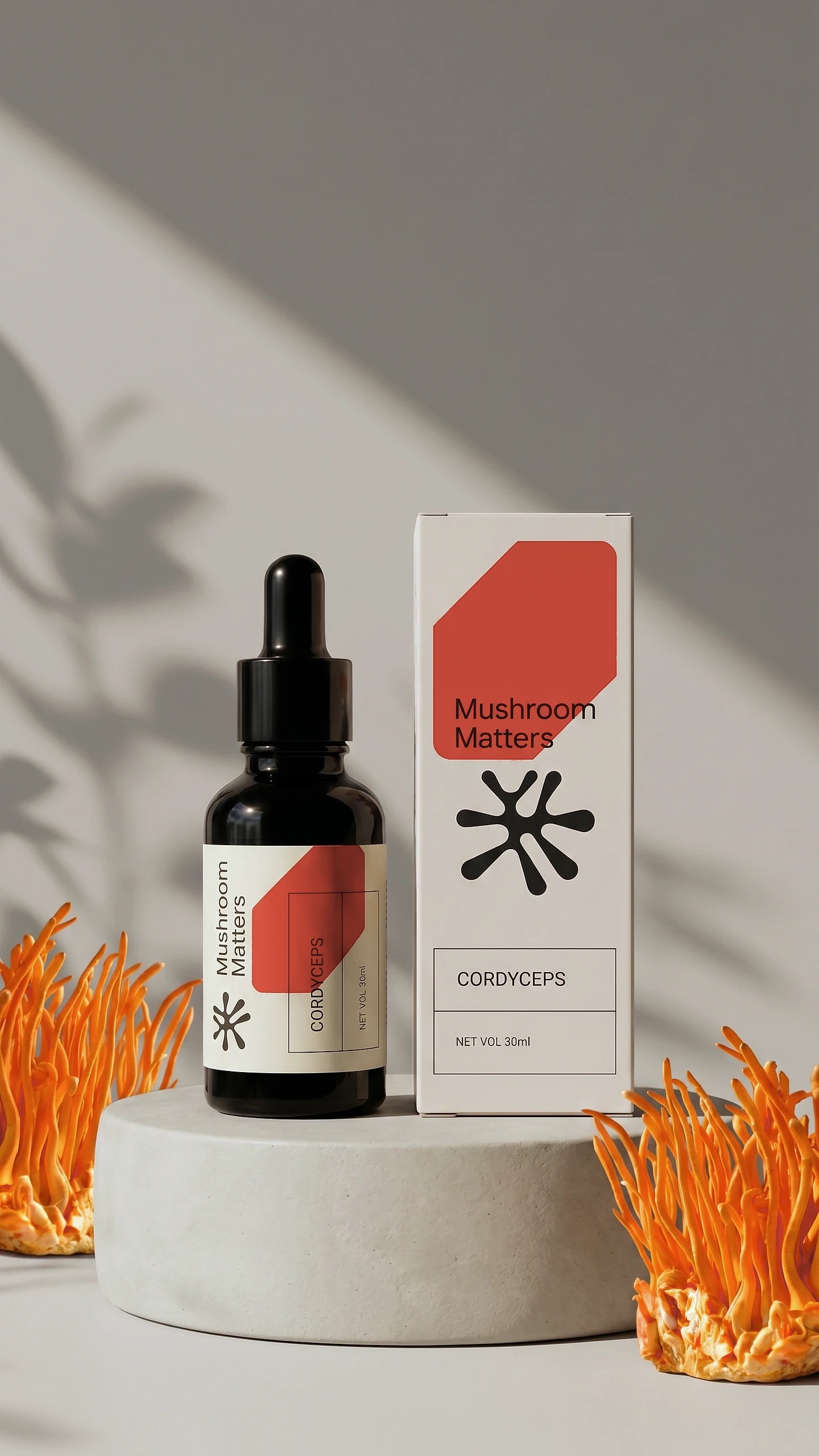
We make our cordyceps extract in Yerevan from Cordyceps militaris fruiting bodies we grow ourselves, by dual extraction — hot water and ethanol in turn, with the alcohol removed before bottling and no powder added to the finished liquid. A 30 ml dropper bottle is 12,000 ֏, certified for the EAEU market (declaration No. RU Д-AM.РА02.В.39933/25), with free delivery in 1–2 days across Yerevan and up to a week anywhere else in Armenia. If you train and you are curious whether steadier energy suits you better than another coffee, this is the mushroom to test — patiently, daily, over the weeks the research asked for. Give it the bottle and your attention, and let the third week tell you more than the first one can.
Read next
Sources
- Hirsch et al., 2017 · Cordyceps militaris blend, 1 vs 3 weeks (Journal of Dietary Supplements)
- Farzan & Koushkie Jahromi, 2026 · acute Cordyceps militaris, crossover trial (PLoS One)
- Chen et al., 2010 · Cs-4 in adults 50–75, 12 weeks (Journal of Alternative and Complementary Medicine)
- Parcell et al., 2004 · Cs-4 in trained cyclists, 5 weeks, no effect (Int J Sport Nutr Exerc Metab)
- Fredholm et al., 1999 · how caffeine acts in the brain (Pharmacological Reviews)
From the shop
Comments
Leave a comment or ask a question.