Reishi for sleep: what is known, how to take it, and how it differs from melatonin
Reishi is not a sleeping pill. What animal studies and human trials actually show, how it differs from melatonin, and how to take it in the evening.
Contents
- Two different ways to “help sleep”
- What the animal studies found
- And in people? Very little, honestly
- Reishi or melatonin: different problems, not rivals
- How to take reishi in the evening
- Who should be careful
- Will I feel it the first night?
- Can I combine it with melatonin?
- Will I wake up groggy?
- The calm end of the shelf
The honest answer first: reishi is not a sleeping pill, and nothing in the research makes it one. It does not knock you out, it does not work on demand tonight, and no study has shown that it cures insomnia in people. What the evidence does suggest is narrower and more interesting: in animal experiments, extracts of Ganoderma lucidum lengthened sleep and shortened the time it took to fall asleep, through mechanisms tied to calming neurotransmitters rather than to the body’s clock. That is a fundamentally different job from melatonin, and understanding the difference is the whole point of this guide. Below: what the studies actually found, what they cannot tell you, how to take our liquid extract in the evening, and who should talk to a doctor first.
Two different ways to “help sleep”
Melatonin is a hormone. Your pineal gland releases it when light fades, and its message to the body is essentially a timestamp: it is night now, run the night program. Taken as a supplement, melatonin mainly moves or reinforces that timestamp, which is why it is most useful for jet lag and for people whose internal clock has drifted late. It speaks to the circadian system — the question of when sleep should happen.
Reishi works in a different register altogether. In Chinese tradition the mushroom has been used for centuries as a calming, “An-Shen” remedy for restlessness and a troubled mind — not as a knockout drop, but as something that settles a nervous system that will not quiet down on its own. Its best-studied compounds are the triterpenes (the ganoderic acids) and the beta-glucan polysaccharides, and the experimental findings so far point at the calming side of the brain’s chemistry: GABA, serotonin, even inflammatory signalling molecules. The claim, to the extent the evidence supports one, is about the quality of winding down, not about the timing of sleep.
What the animal studies found
Three experiments are worth knowing in their actual shape. The oldest is Chu and colleagues, 2007 (Pharmacology, Biochemistry and Behavior): a water extract of reishi made rats fall asleep faster and sleep longer — but only in animals that had been given pentobarbital, a barbiturate. The effect was partly blocked by flumazenil, a drug that plugs benzodiazepine receptors, which points to GABA, the brain’s main calming neurotransmitter. The detail that rarely makes it into marketing: in normal, undrugged rats, the same extract changed nothing about their sleep at all. That is a calming profile, not a sedative one.
The second study is Cui and colleagues, 2012 (Journal of Ethnopharmacology). Freely moving rats were given a reishi extract for three days and then recorded on EEG overnight. At 80 mg/kg the animals slept more overall and specifically got more non-REM sleep, the deep restorative kind, while REM sleep and slow-wave structure were unchanged. The effect travelled with a rise in TNF-alpha, a signalling molecule better known from immunology that also participates in sleep regulation — a reminder that sleep and the immune system talk to each other constantly, and that a mushroom studied for immune modulation showing up in sleep research is not as strange as it sounds.
The third and most surprising is Yao and colleagues, 2021 (Scientific Reports). Mice received an acidic fraction of the alcohol extract of reishi mycelium for 28 days; they fell asleep faster and slept longer in the standard pentobarbital test. The mechanism proposed is genuinely unusual: the effect ran through the gut microbiome. The extract shifted gut bacteria, that shift raised serotonin in the hypothalamus, and when the researchers wiped out the microbiome with antibiotics, the sleep effect disappeared with it. Twenty-eight days of daily use, a chain through the intestine to the brain — this is about as far from “take one tonight and sleep” as a mechanism can get.
And in people? Very little, honestly
Here is the part a responsible article has to say plainly: no randomised controlled trial has ever tested reishi against insomnia in humans. Not one. Every confident claim you have read about reishi and human sleep is built on those rodent studies above, plus tradition, plus a neighbouring data point: the 2005 trial by Tang and colleagues in people with neurasthenia, a diagnosis centred on chronic exhaustion. In that study 132 patients took a reishi polysaccharide extract (1,800 mg three times a day) or placebo for eight weeks; fatigue scores fell 28.3% against 20.1% on placebo, and sense of well-being rose 38.7% against 29.7%. Real numbers, a real gap — but the outcome measured was fatigue and well-being, not sleep. A tired person who feels better may sleep better; a study that did not measure sleep cannot tell us so.
Reishi or melatonin: different problems, not rivals
Framed honestly, these two do not compete — they answer different questions. Melatonin answers “when”: it is the tool for a clock that needs shifting, for jet lag, for the person whose body insists on 3 a.m. when life requires 11 p.m. A 2022 meta-analysis in the Journal of Neurology pooled 23 randomised trials and found melatonin modestly improved measured sleep quality, though with high variability between studies — useful, but not a master key. Reishi answers a different question entirely: not “when should I sleep” but “why won’t my mind let go at the end of the day”. If your problem is a late-shifted clock, a mushroom extract will not move it. If your problem is a laptop closed at midnight with your head still running, that is the territory where reishi’s calming research actually lives.
Neither one replaces the boring fundamentals. A dark cool room, a regular wake time, no bright screen in the last hour — these move sleep more reliably than anything in a bottle. A supplement, whichever kind, is an addition to that base, not a substitute for it. And if poor sleep has gone on for months, that is a reason to see a doctor, not to escalate doses.
How to take reishi in the evening
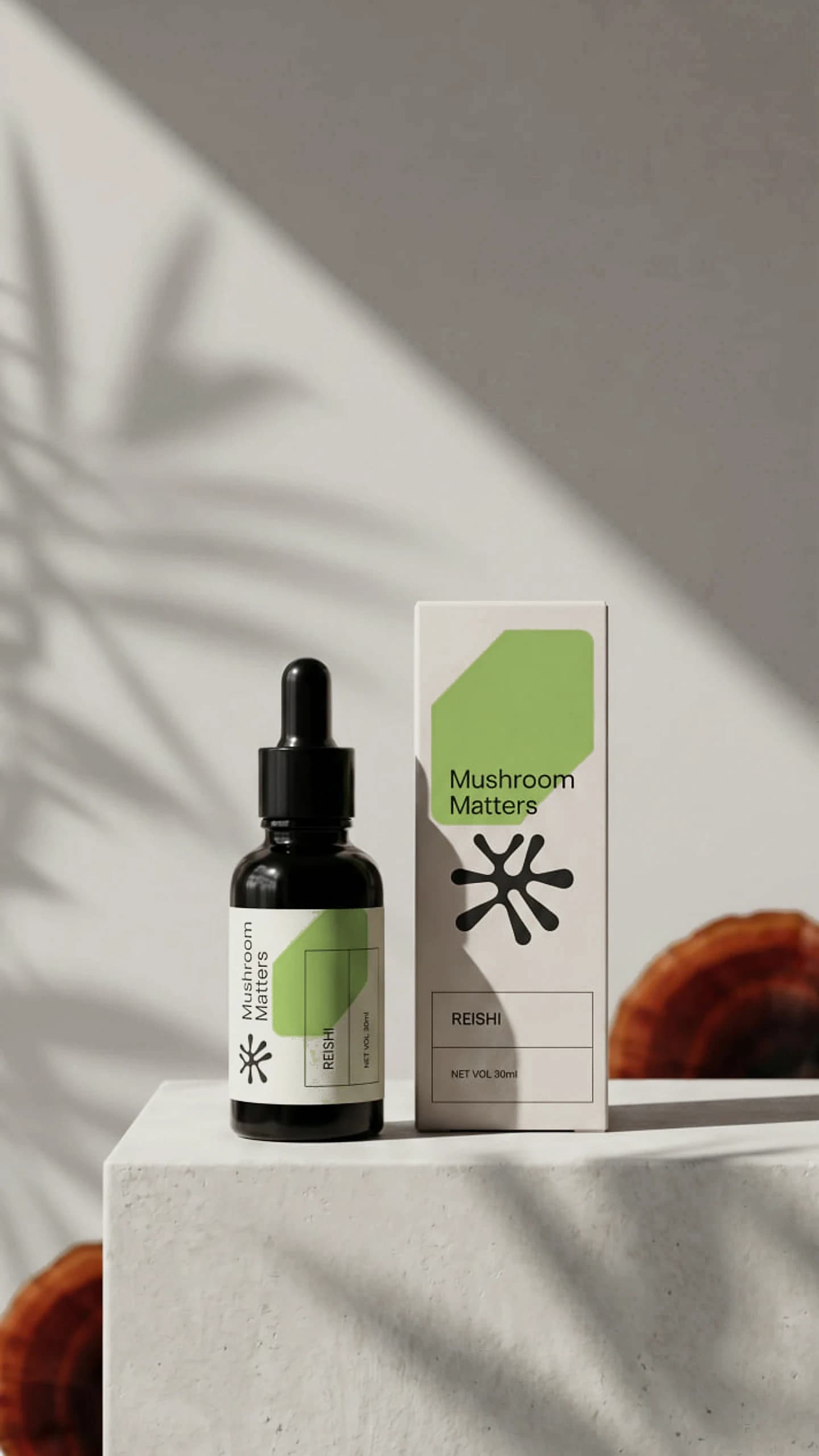
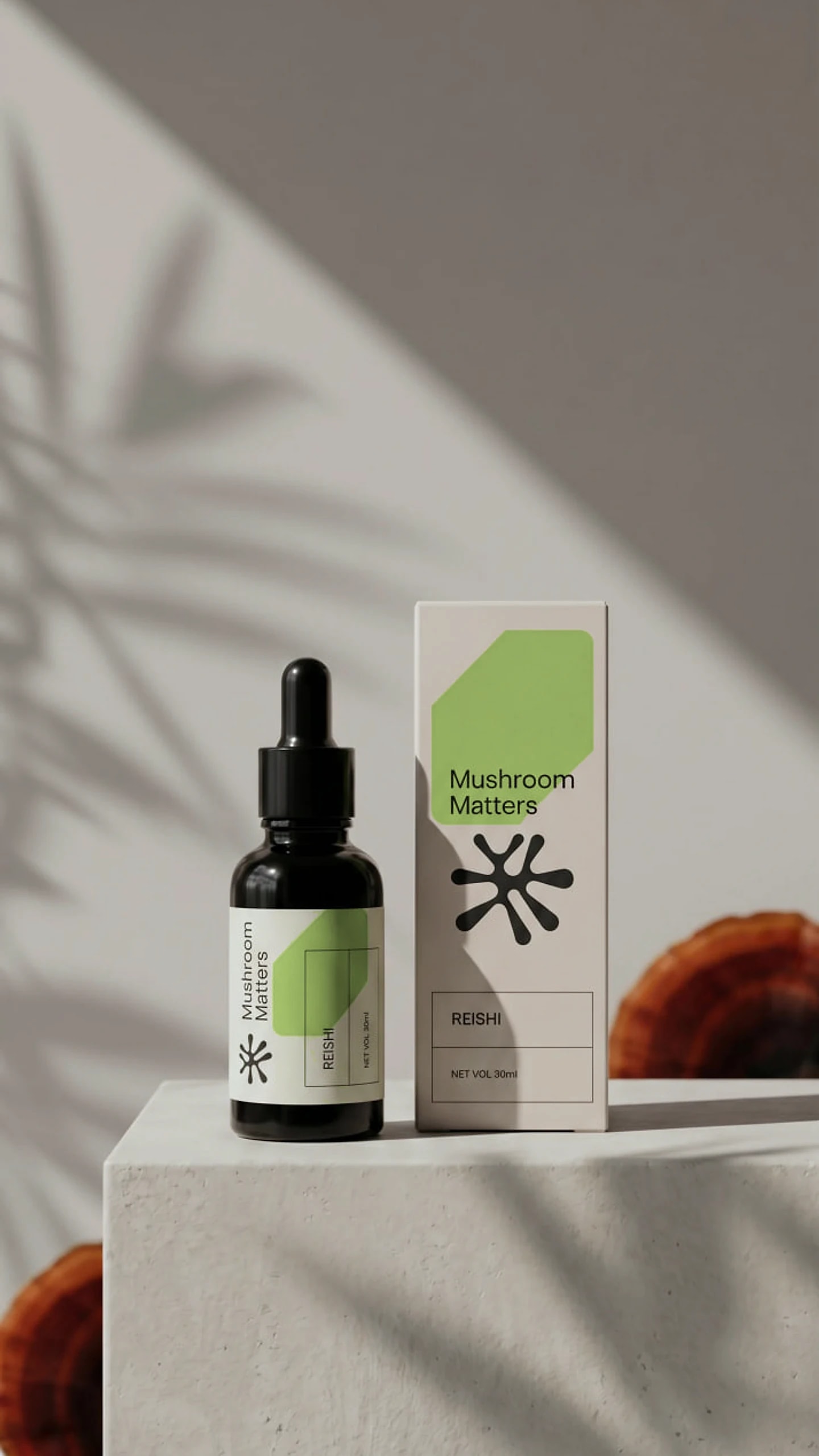
For our liquid dual-extract the label directions are 1–2 ml once a day. One dropper holds about 0.5 ml, so that is two to four full droppers, taken under the tongue or stirred into water or caffeine-free herbal tea. For a sleep-oriented routine, the sensible slot is one to two hours before bed — close enough to be part of the wind-down, early enough that you are not getting back up. Fold it into whatever already marks the end of your working day: the kettle, dimmed lights, a book. The extract does not force sleep, so the ritual around it does part of the work.
Consistency matters more than any single evening. The animal studies that found effects ran for three to twenty-eight days; the human neurasthenia trial ran for eight weeks. Nothing here suggests an on-off switch, and we will not pretend otherwise: we cannot promise that you will notice a difference, or when. What we can say is that a daily habit for several weeks is the shape the research took. At 1–2 ml a day, a 30 ml bottle covers 15–30 days — that is a volume calculation, not a promised course. Store the bottle sealed, at +5 to +25°C, away from direct sun.
Who should be careful
Reishi is a functional food, not a medicine, and for most healthy adults it is well tolerated. But some situations call for a doctor’s opinion before the first dropper. If you take anticoagulants or other blood-thinning medication, reishi is a known caution. If you are pregnant or breastfeeding, the safety data simply do not exist — skip it. If you live with an autoimmune condition or take immunosuppressants, remember that this mushroom is studied precisely for its effects on immune signalling, which is the last thing you want to layer onto immunosuppressive therapy without supervision. The same applies before planned surgery. When any of these apply, this is a conversation for your doctor, not for a product page.
Will I feel it the first night?
Probably nothing dramatic, and that is the honest expectation. The mechanism suggested by the research — gradual, gut-and-neurotransmitter-mediated, building over days and weeks — is the opposite of an acute sedative. Some people describe the first weeks simply as calmer evenings. Judge it, if you judge it at all, over a month of consistent use, not a single night.
Can I combine it with melatonin?
Nobody has studied the combination, so there is no evidence either way — no proven synergy, but also no established interaction. What we would say is simpler: start with one thing at a time. If you add both at once and sleep changes, you will never know which did it, and if something disagrees with you, you will not know which to drop. One change, a few weeks, then decide.
Will I wake up groggy?
There is no reason to expect a hangover effect, because reishi is not a sedative and does not sedate. Morning grogginess is a known complaint with sedating sleep aids and higher doses of melatonin; nothing in the reishi research or in the reports we hear points that way. That said, every body is different — if mornings feel heavier, take it earlier in the evening and see.
The calm end of the shelf
We make our reishi extract in Yerevan from Ganoderma lucidum fruiting bodies we grow ourselves, by dual extraction: hot water pulls the polysaccharides, alcohol pulls the triterpenes, and the alcohol is removed before bottling. No powder is added to the finished liquid. It comes in a 30 ml dropper bottle, certified for the EAEU market, with free delivery across Armenia. If your evenings have been louder than you would like, this is the calm end of the mushroom shelf — taken daily, alongside the boring fundamentals, with honest expectations. Give it a month and your own attention, and let that be the verdict.
Read next
Sources
- Yao et al., 2021 · Reishi, gut microbiota and sleep in mice (Scientific Reports)
- Cui et al., 2012 · Reishi extract prolongs sleep in rats (Journal of Ethnopharmacology)
- Chu et al., 2007 · Reishi and GABAergic sleep mechanisms (Pharmacology, Biochemistry and Behavior)
- Tang et al., 2005 · Reishi polysaccharides in neurasthenia (Journal of Medicinal Food)
- Fatemeh et al., 2022 · Melatonin and sleep quality, meta-analysis (Journal of Neurology)
From the shop
Comments
Leave a comment or ask a question.