Adaptogens: an honest guide to what they are and what to expect
Where the word “adaptogen” came from, what trials actually show for ashwagandha, rhodiola and ginseng, and why mushrooms are a separate story.
Contents
- A Soviet term, born from stimulant research
- Why the term is contested
- Ashwagandha: the strongest card in the deck
- Rhodiola and ginseng: thinner than the legend
- Where medicinal mushrooms sit on this map
- Three reasons an adaptogen “doesn’t work”
- How to choose: four questions that survive marketing
- Where our three mushrooms fit — without the hard sell
- Can I combine several adaptogens?
- Do I need to take breaks or cycle them?
- Can I take them with coffee?
- The honest bottom line
The direct answer first. An adaptogen is a substance claimed to raise the body’s general, non-specific resistance to stress — in theory, helping your stress-response system hold its balance under load rather than pushing you up or pulling you down. The word was coined in Soviet pharmacology in the late 1940s and defined as a formal category by 1969. Today it is mostly a marketing label: regulators do not recognise it as a health claim, and the evidence behind the category is uneven. Some adaptogens have decent small human trials, most have thin ones, and the medicinal mushrooms — lion’s mane, reishi, cordyceps — rest mainly on animal research plus a few small studies in people. This guide maps that evidence honestly, explains why adaptogens so often “don’t work”, and shows how to choose without guessing.
A Soviet term, born from stimulant research
The story starts in the 1940s USSR, which wanted pilots, sailors and factory workers to keep performing under extreme conditions. Early work on Schisandra chinensis — a berry Far Eastern hunters used against fatigue — led the toxicologist Nikolai Lazarev to propose in 1947 a class of substances that raise the “state of non-specific resistance” to stress: adaptogens. The concept leaned on Hans Selye’s three-phase model of stress — alarm, resistance, exhaustion; an adaptogen, the theory went, stretches the resistance phase and softens the crash into it.
By 1969, Israel Brekhman and Igor Dardymov had turned the idea into a formal definition in the Annual Review of Pharmacology, with three criteria: an adaptogen is harmless at normal doses, raises resistance to stressors of any kind — physical, chemical, biological — and has a “normalising” effect, nudging the body toward balance whichever way it has drifted. That last clause is the famous one: the same plant should calm the over-wound and lift the depleted. An elegant idea — and the reason scientists still argue about the term, because “normalises whatever is wrong” is a very hard claim to test.
Why the term is contested
Three reasons. First, the mechanism is broad rather than precise: modern reviews tie adaptogen effects to the hypothalamic–pituitary–adrenal axis, cortisol and stress-response proteins like HSP70, but a mechanism that explains everything risks explaining nothing in particular. Second, “adaptogen” is not a regulated category: the European Food Safety Authority’s guidance on health claims treats “adaptogenic” effects as not defined precisely enough to assess, and no adaptogen claim is authorised in the EU. Third, the category lumps together very different plants and fungi with very different evidence bases — the next section sorts that out.
Ashwagandha: the strongest card in the deck
If any adaptogen can point to placebo-controlled human trials on stress, it is ashwagandha (Withania somnifera). The most cited is Chandrasekhar and colleagues, 2012: 64 adults with chronic stress took 300 mg of a concentrated root extract twice a day for 60 days; scores on every stress scale used fell significantly against placebo, and morning cortisol dropped significantly more in the treatment group. In a second trial (Lopresti and colleagues, 2019), 60 stressed but healthy adults took 240 mg of a standardised extract daily for 60 days: anxiety scores improved significantly, and morning cortisol fell further than on placebo.
Now the honesty clause. These are trials of dozens of people, not thousands, most run on specific branded extracts, and independent replication is still limited. The honest reading is not “ashwagandha treats anxiety” — it is “ashwagandha is the one adaptogen where small human trials on stress actually exist and mostly point the same way”. If you buy it, the evidence argues for a standardised root extract at the studied dose, daily, for weeks — not a pinch of powder in a smoothie.
Rhodiola and ginseng: thinner than the legend
Rhodiola rosea is the adaptogen with the most romantic backstory — Soviet cosmonauts, Arctic endurance — and a systematic review tells you what that story is worth. In 2011 Hung, Perry and Ernst found eleven placebo-controlled trials on physical performance, mental performance and mental health. Their verdict: rhodiola may have beneficial effects, but the trials are small, heterogeneous and short on independent replications. “May” is the operative word.
Ginseng is the name that sells the whole category, and its human evidence is the most sobering. The 2010 Cochrane review of ginseng for cognition found nine randomised placebo-controlled trials and could not even pool them: doses, durations and outcome measures differed too much. The authors’ conclusion: no convincing evidence of a cognitive-enhancing effect in healthy people. The world’s most famous adaptogen is also a lesson in the difference between fame and proof.
Where medicinal mushrooms sit on this map
Lion’s mane, reishi and cordyceps are routinely sold under the adaptogen umbrella, so let’s place them honestly. The bulk of their research is cell and animal work: erinacines stimulating nerve growth factor synthesis in rodents, reishi extracts lengthening sleep in rats, cordycepin’s links to cellular energy. Human data exists but is small. For lion’s mane: a 30-person trial from 2009 in mild cognitive impairment, with gains that faded after the powder was stopped. For reishi: a 132-patient trial from 2005 in neurasthenia that measured fatigue and well-being, not sleep. For cordyceps: a 28-person trial from 2017 that found improved oxygen use after three weeks of a mushroom blend. Each is a signal in a specific group on a specific preparation, not a promise about any bottle on any shelf. We unpack each study in our separate articles on lion’s mane, reishi and cordyceps; here the point is simpler: mushrooms are the “promising, early” floor of the adaptogen map, not the proven top.
Three reasons an adaptogen “doesn’t work”
The first is expectation. Adaptogens are not stimulants: nothing switches on after the first dose. If you are waiting for the clean jolt coffee gives you, any adaptogen will feel like nothing — because “nothing dramatic” is more or less the correct sensation. The second is duration. The trials above ran for 60 days, three weeks, sixteen weeks; whatever these substances do appears to be cumulative. The third is the product itself. A jar that says “adaptogen” might hold a standardised extract at the studied dose — or dried grain with mycelium, or a powder that never saw an extraction step.
How to choose: four questions that survive marketing
Forget the word “adaptogen” on the label and ask four factual questions. What exactly is the raw material — which species, which part of the plant or fungus, grown on what? Was it extracted, and with what — for mushrooms, the honest options are hot water, alcohol, or both (a dual extraction), because the interesting compounds split by solubility. What is the composition — is there a measured figure for the relevant compounds rather than a vague percentage of “polysaccharides”, which can legally include grain starch? And who made it — is there a named manufacturer who answers questions, with registration documents you can actually look up? A seller who answers all four plainly has done the work. A seller who answers with adjectives has told you something too. Our guides to dual extraction and to comparing extracts, powders and capsules walk through each question in detail.
Where our three mushrooms fit — without the hard sell
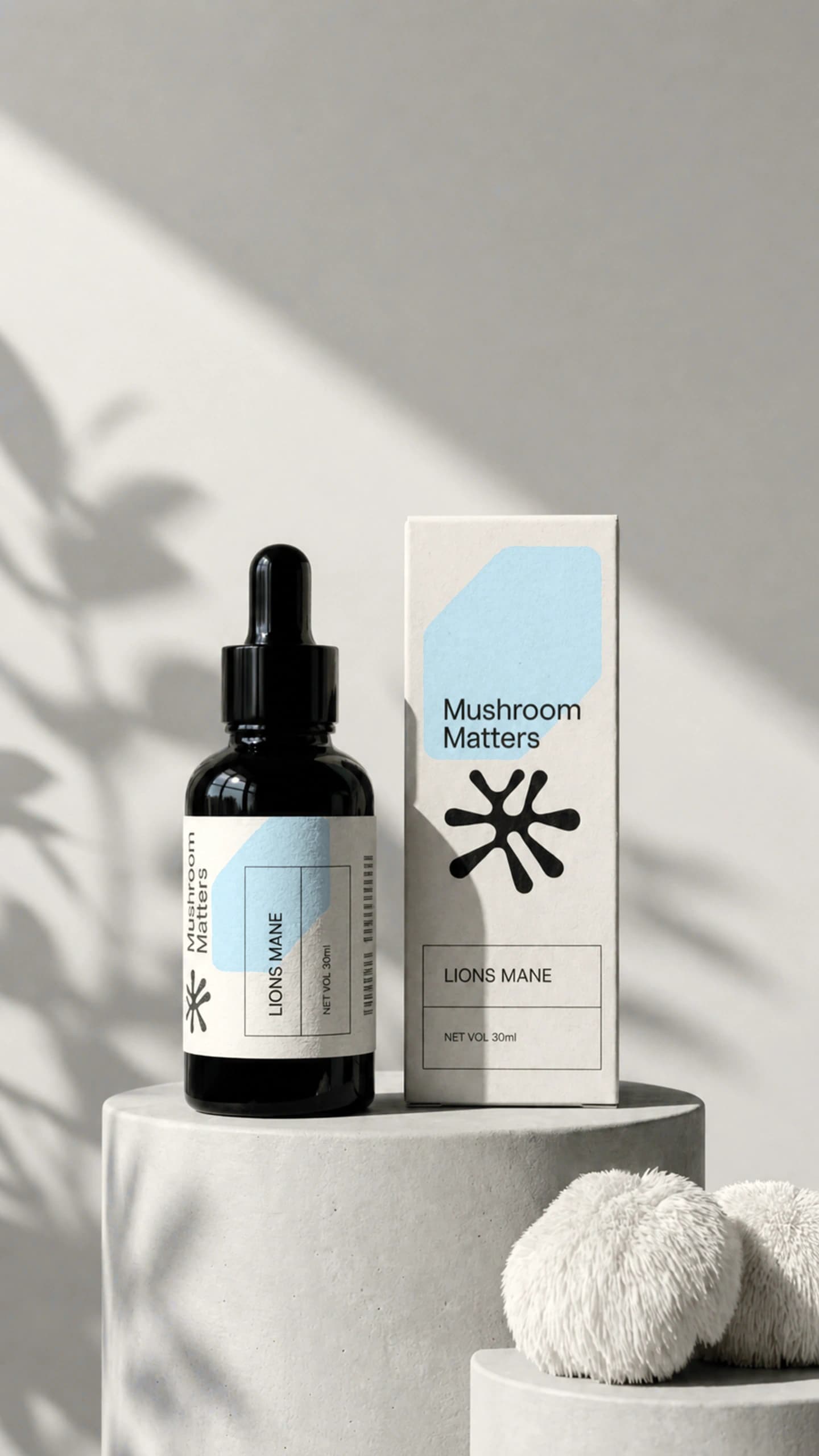
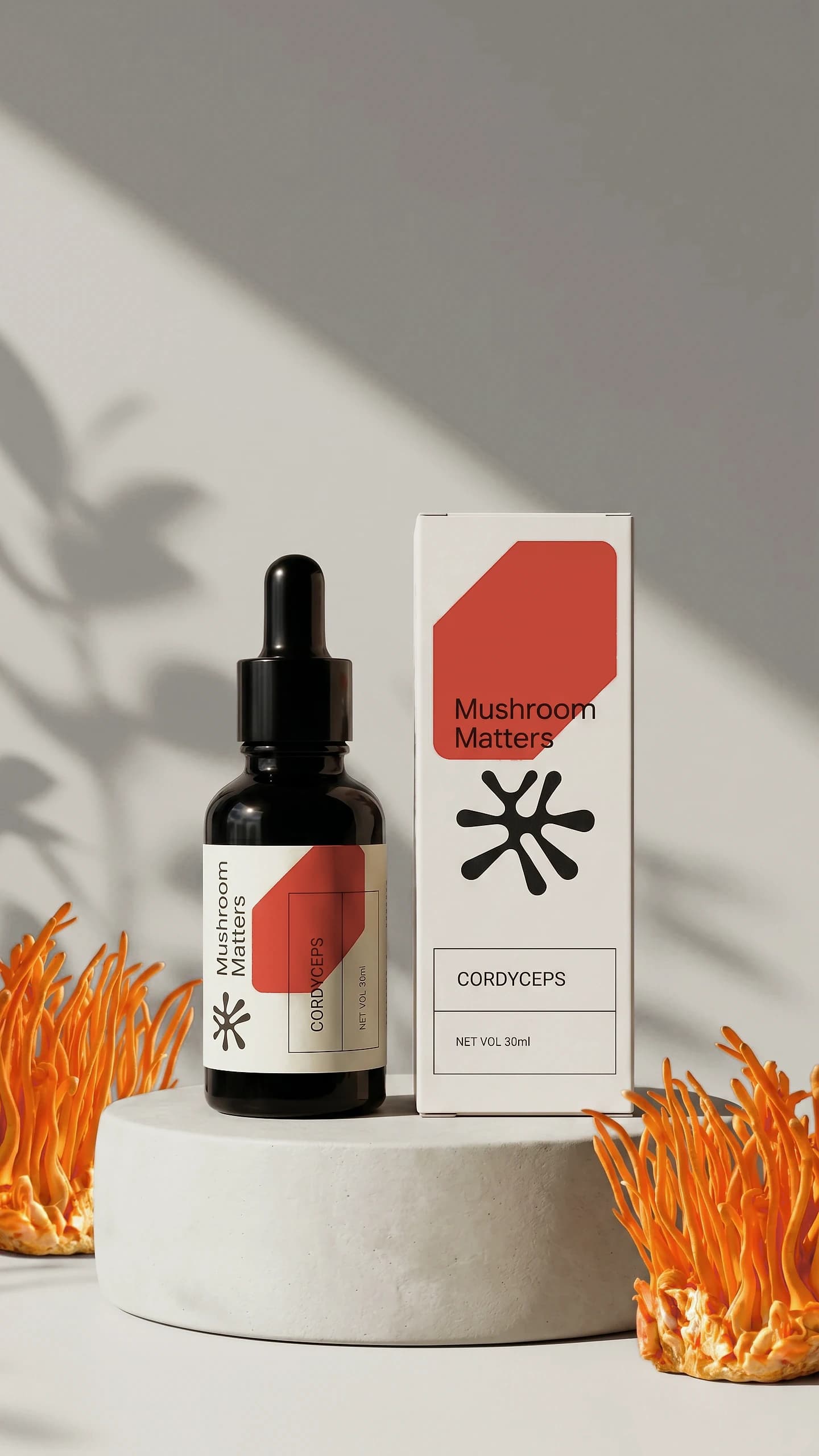
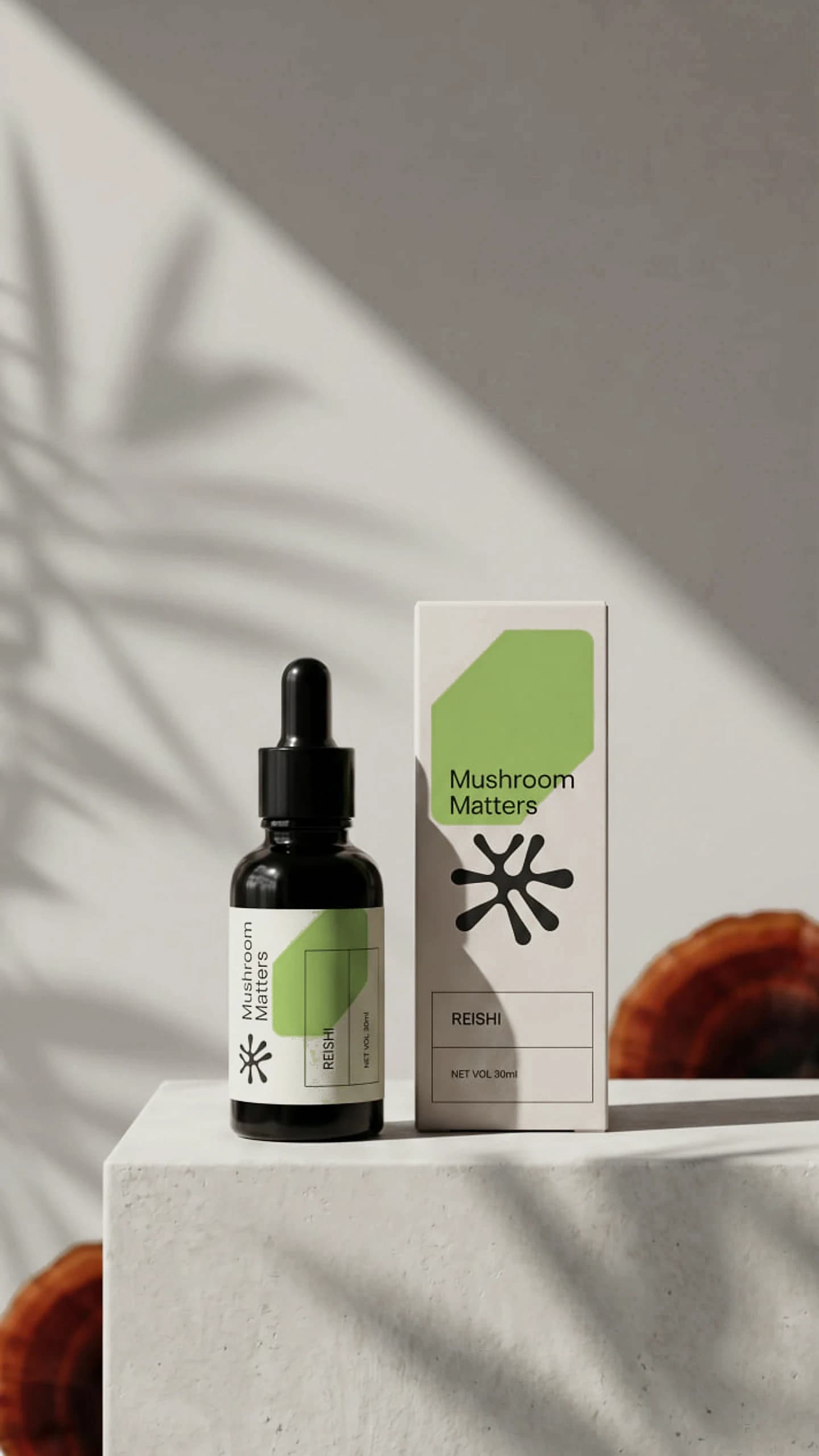
Full disclosure, plainly: we are a producer. Mushroom Matters grows lion’s mane mycelium, reishi and cordyceps fruiting bodies in Yerevan, runs both extraction stages — water and alcohol — removes the alcohol, and bottles the result as 30 ml dropper extracts, with the EAEU declaration of conformity (№ RU Д-AM.РА02.В.39933/25) and free delivery across Armenia. We make them because the mushroom research is genuinely interesting. We describe them inside the adaptogen frame with the same caveat we give everyone else: the human evidence for our three mushrooms is early and small, our extracts are functional foods rather than medicines, and the label serving of 1–2 ml a day is a direction of use, not a promise of an outcome. If the evidence map in this article makes sense to you, you now know exactly which floor of it we stand on.
Can I combine several adaptogens?
Combinations are barely studied, so nobody can honestly promise you synergy. What we suggest is simpler: start with one, give it a few weeks of daily use, and only then decide whether to add a second. If you start three at once and feel better — or worse — you will never know which one did it.
Do I need to take breaks or cycle them?
You will read about mandatory “cycling” everywhere, but the clinical trials generally ran continuously for their full duration — eight, twelve, sixteen weeks — without breaks, and no study has established that cycling is required. What the research does show is that effects can fade after you stop: in the 2009 lion’s mane trial, the gains dissolved within four weeks of stopping. The practical takeaway is not “cycle to stay safe” but “these are not permanent changes — they last while the habit lasts”.
Can I take them with coffee?
There is no established conflict: caffeine is a stimulant that masks fatigue by blocking adenosine receptors, while adaptogens are claimed to work on the stress-response system — different mechanisms, and no interaction is documented. Just keep the roles straight. Coffee changes how you feel in the next hour; an adaptogen, if it does anything, changes how you handle the next month. One does not replace the other.
The honest bottom line
“Adaptogen” is a useful shelf label with a real history and an uneven evidence base. Ashwagandha has the best small human trials on stress, rhodiola has suggestive ones, ginseng’s fame outruns its data, and the medicinal mushrooms are genuinely promising but early. None of them is a switch, none works in five days, and none replaces sleep, workload hygiene or a doctor when something is actually wrong. If you are pregnant, taking medication — especially blood thinners, immunosuppressants or sedatives — or managing a diagnosed condition, that is a conversation for your doctor before any bottle. If you want to test the category: one product, a transparent producer, several weeks of daily use, and your own attention as the measuring instrument.
Read next
Sources
- Panossian & Wikman, 2010 · Adaptogens and the central nervous system: history and mechanisms (Pharmaceuticals)
- Brekhman & Dardymov, 1969 · The original definition of adaptogens (Annual Review of Pharmacology)
- Todorova et al., 2021 · Plant adaptogens: history and future perspectives (Nutrients)
- Chandrasekhar et al., 2012 · Ashwagandha root extract for stress, RCT (Indian J Psychol Med)
- Lopresti et al., 2019 · Ashwagandha, cortisol and anxiety, RCT (Medicine)
- Hung, Perry & Ernst, 2011 · Rhodiola rosea: systematic review of RCTs (Phytomedicine)
- Geng et al., 2010 · Ginseng for cognition (Cochrane Database of Systematic Reviews)
- EFSA, 2011 · General guidance on health claims: “adaptogenic” effects as insufficiently defined (EFSA Journal 9(4):2135)
- NCCIH (NIH) · Ashwagandha: what the research says and safety notes
From the shop
Comments
Leave a comment or ask a question.