How long does Reishi take to work?
Reishi works on a scale of weeks, not evenings. What the human and animal studies actually timed, what to expect in weeks one to eight, and when to stop.
The direct answer: reishi works on a scale of weeks, not days — and for some people, honestly, not at all. No study shows an effect from the first dose or the first evening. The human trial people cite most ran for eight weeks before its results were counted; a smaller pilot saw its changes at four. The animal studies that found anything ran from three days to four weeks of daily administration. So the realistic frame is this: take your daily 1–2 ml, expect nothing dramatic in week one, and plan a fair judgement at four to eight weeks. Everything below is the detail behind those numbers — what exactly was measured, what the timeline looks like week by week, and what to do if the bottom of the second bottle arrives with nothing to show for it.
The first one to two weeks: what is realistic
Almost certainly nothing you could point at. That is not a hedge — it is what the evidence predicts. Reishi is not a sedative and does not sedate: in the 2007 study by Chu and colleagues, an aqueous reishi extract changed nothing about the sleep of normal, undrugged rats at all. Whatever calming effect the mushroom has showed up only alongside a barbiturate, through GABAergic pathways — a profile of settling, not of switching off. A compound with that profile does not announce itself on Tuesday. What some people report in the first weeks is quieter than an effect: evenings that feel marginally less loud, an easier slide from laptop to bed. Treat such impressions as anecdotes, including your own — the first two weeks are for building the habit, not for scoring it.
One thing week one is good for: logistics. Find the fixed slot you will actually keep — for most people that is an hour or two before bed, folded into whatever already marks the end of the working day. Two to four droppers under the tongue or in a glass of water, the bottle back on its shelf, sealed. If you miss a day, take the normal serving tomorrow; doubling up to compensate is not a thing the research supports.
What the studies actually timed
The animal work is the fast end of the timeline, and it is worth knowing in its real shape. In Cui and colleagues, 2012 (Journal of Ethnopharmacology), freely moving rats received a reishi extract for three days; on the third night their EEG showed more total sleep and specifically more non-REM sleep at 80 mg/kg, alongside a rise in TNF-alpha, an immune signalling molecule that also takes part in sleep regulation. Three days sounds encouraging until you remember these are rats at doses scaled for a laboratory, and that the effect was blocked when the researchers neutralised TNF-alpha — the sleep change travelled with immune signalling, not around it.
The slow end is more instructive. In Yao and colleagues, 2021 (Scientific Reports), mice took an acidic fraction of the alcohol extract of reishi mycelium for twenty-eight days before the sleep effect was measured — and the proposed mechanism ran through the gut microbiome: the extract shifted gut bacteria, that shift raised serotonin in the hypothalamus, and when the microbiome was wiped out with antibiotics, the effect disappeared with it. A mechanism that needs a month and a working intestine is the opposite of a sleeping pill. It is also, not coincidentally, the closest thing the literature has to an explanation for why reishi is a habit and not an event.
And in people? The landmark is Tang and colleagues, 2005: 132 patients with neurasthenia — a diagnosis built around chronic exhaustion — randomized to a reishi polysaccharide extract (Ganopoly, 1,800 mg three times a day) or placebo for eight weeks. Fatigue fell 28.3% against 20.1% on placebo, sense of well-being rose 38.7% against 29.7%. Real numbers, a real gap — and a necessary caveat: the trial measured fatigue and well-being, not sleep. A second human data point is Zhao and colleagues, 2012: 48 breast cancer patients on endocrine therapy took reishi spore powder for four weeks in an uncontrolled pilot and reported less cancer-related fatigue and better quality of life. No placebo group, a specific patient population, a different preparation. Two studies, two specific groups, both about fatigue — that is the entire human timeline we have. It does not transfer directly to your evenings, and we will not pretend it does.
Weeks four to eight: the fair window
Both human data points land in the same window — four weeks for the pilot, eight for the controlled trial. That is why the honest advice is to judge reishi by the bottom of the bottle, not by the first Friday. Our 30 ml bottle at the label serving of 1–2 ml a day covers fifteen to thirty days, so a fair personal trial is one to two bottles — four to eight weeks of unbroken daily use. That is arithmetic from the volume plus the duration the studies chose, not a prescribed course and not a promise of effect.
What exactly are you watching for in that window? Not a transformation. The changes people describe when reishi suits them are background ones: the end of the day arrives with less static, winding down takes less negotiation, mornings feel a touch less heavy. If you journal sleep or energy even loosely, four weeks of notes beat four weeks of impressions. And keep the boundary in view: these extracts are functional foods, not medicines, and no timeline in this article is a guarantee.
What shifts the timeline
Regularity is the first variable, and it is not close. Every study on the list — three days, four weeks, eight — dosed daily. A person who takes reishi four evenings out of seven is not on a slower version of the same curve; they are mostly off it. Attach the dropper to something that already happens every evening and the problem largely solves itself.
Timing is the second. Reishi belongs to the evening — an hour or two before bed, where its traditional calming use and the modern wind-down routine overlap. The third is format. The research compounds split by solubility: polysaccharides come out in water, triterpenes need alcohol, so a dual extraction is the version of the mushroom that carries both. Ours runs exactly those two stages; the alcohol is removed before bottling, and no powder is added to the finished liquid. What remains is the honest variable we cannot move: you. Baseline stress, caffeine timing, room light, an undiagnosed sleep disorder — any of these can dwarf a mushroom. If your sleep problem is a shifted body clock or a medical condition, no extract is the right tool, and the earlier that is established, the better.
When nothing happens
Say eight disciplined weeks pass and your notes show nothing. First check the boring fundamentals, because they move sleep more reliably than anything in a bottle: a regular wake time, a dark cool room, no bright screen in the last hour, caffeine finished by early afternoon. If those are in place and reishi still has not registered — believe the result. No response after eight honest weeks is a real answer, and the right move is to stop, not to escalate. There is no evidence that more millilitres buy a faster or stronger effect, and the label serving of 1–2 ml is where we would keep it regardless.
And one line that matters more than the mushroom: if poor sleep or exhaustion has gone on for months, if you wake unrefreshed no matter what, or if the fatigue is heavy enough to bend your days around it — that is a reason to see a doctor, not to buy a third bottle. Reishi is a functional food. It sits on top of a working foundation; it does not substitute for one, and it does not treat anything.
Will I feel it the first night?
Almost certainly not, and anything you do feel is more likely the ritual than the mushroom. None of the research — animal or human — shows an acute effect, and the mechanisms proposed are the slow kind. Plan your first night around building the habit, and your judgement around week six.
Should I take more to get there faster?
There is no evidence that it would. The studies fixed a daily amount and waited; none tested escalation. Stay within the label serving of 1–2 ml — two to four full droppers — and let time do the variable part. If a larger dose tempts you because nothing is happening, reread the section above: nothing happening in week one is the expected state, not a dosing error.
How long can I keep taking it?
The controlled human trial ran eight weeks and reported the extract well tolerated; beyond that, the data simply end. Many people take functional mushrooms continuously, and tradition is long — but tradition is not a safety study. Our honest frame is periodic review: every couple of months, look at your own notes and ask whether the bottle is still earning its place in the evening. If the answer stops being yes, that is your answer too.
The bottle itself
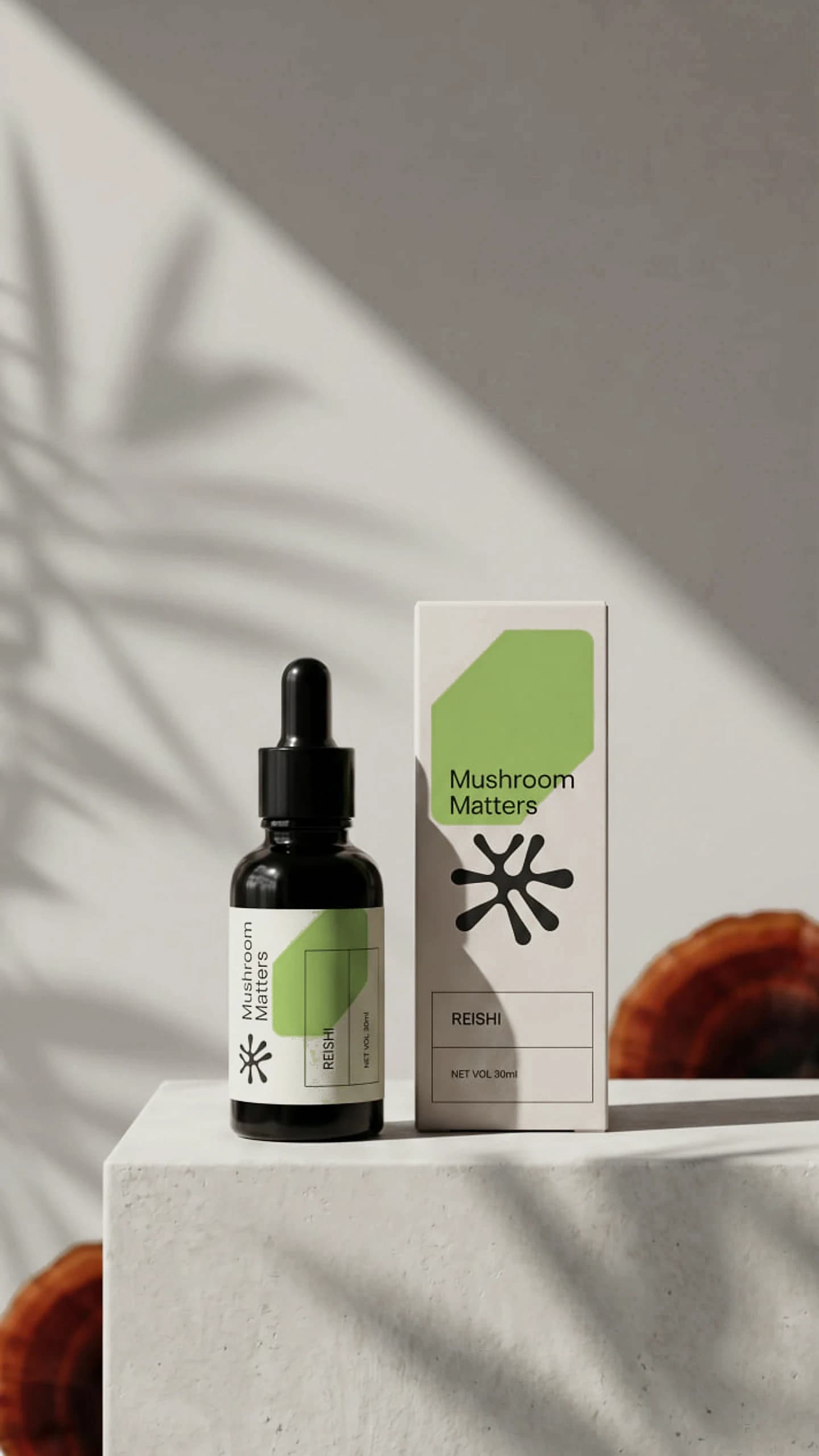
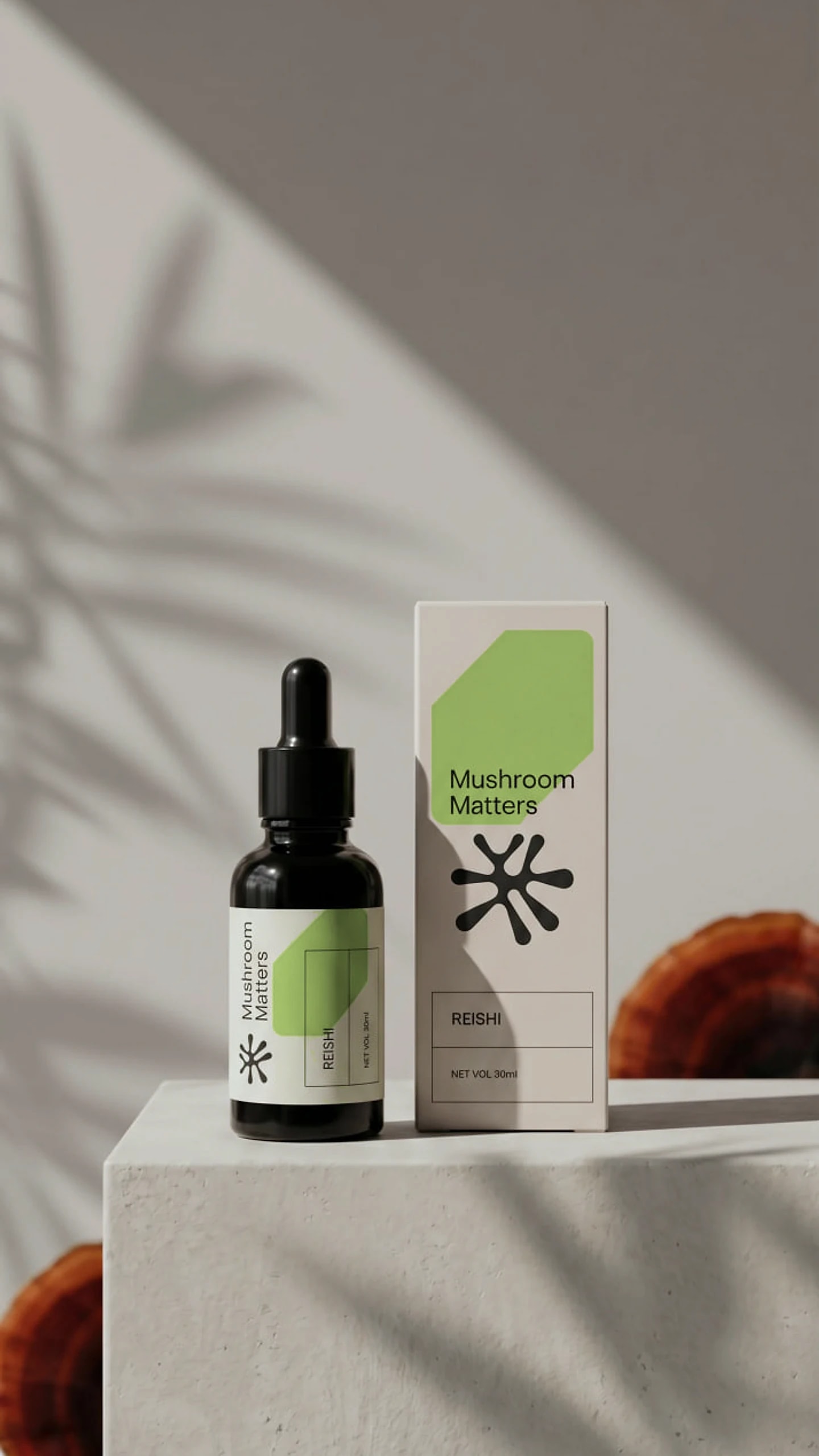
Our reishi is a liquid dual-extract of Ganoderma lucidum fruiting bodies we grow ourselves, made and bottled in Yerevan: hot water pulls the polysaccharides, alcohol pulls the triterpenes, the alcohol is removed, no powder goes in. A 30 ml dropper bottle costs 12,000 ֏, with free delivery in one to two days across Yerevan and up to seven days elsewhere in Armenia. The production complies with the EAEU technical regulations, declaration of conformity No. RU Д-AM.РА02.В.39933/25. Take 1–2 ml each evening, give it the four to eight weeks the research asked for, keep your own notes — and let those, not this article, deliver the verdict.
Read next
Sources
- Tang et al., 2005 · Reishi polysaccharides in neurasthenia, 8-week RCT (Journal of Medicinal Food)
- Zhao et al., 2012 · Reishi spore powder and cancer-related fatigue, 4-week pilot (eCAM)
- Cui et al., 2012 · Reishi extract prolongs sleep in rats after 3 days (Journal of Ethnopharmacology)
- Chu et al., 2007 · Reishi and GABAergic sleep mechanisms (Pharmacology, Biochemistry and Behavior)
- Yao et al., 2021 · Reishi, gut microbiota and sleep after 28 days in mice (Scientific Reports)
From the shop
Comments
Leave a comment or ask a question.